Hardwood Floor Water Damage Restoration Orlando, FL — Save the Floors.
"Can the floors be saved?" is the first question we hear on every water damage call from an Orlando homeowner with original hardwood. In most cases, yes — if we start within 24 hours. After 48–72 hours in Orlando's humidity, cupping and buckling become permanent.
The 24-Hour Window for Hardwood Floor Salvage in Orlando
Hardwood flooring is porous — it absorbs water fast and releases it slowly. In a dry climate with 40–50% ambient humidity, natural evaporation assists drying. In Orlando at 74–77% RH, hardwood sitting wet doesn't dry naturally — it cups, buckles, and warps.
The timeline for permanent damage in Central Florida:
Can wet hardwood floors be saved in Orlando?
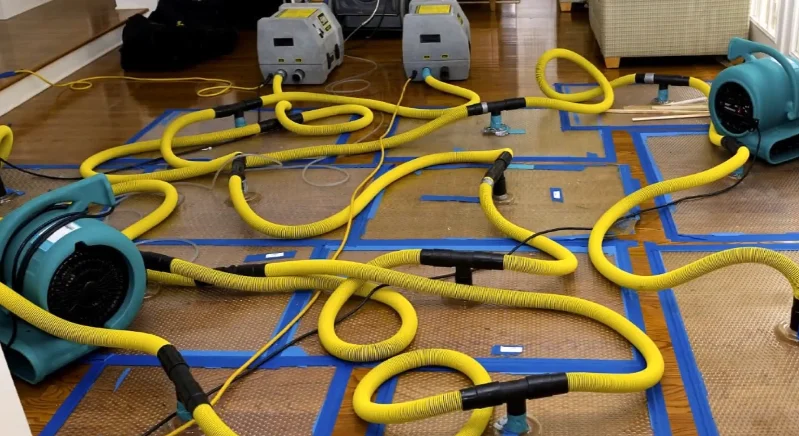
In the majority of cases where professional drying begins within 24 hours, yes. We use specialized floor-drying mat systems that create negative pressure through the floor face, drawing moisture up and out through channels between boards. Combined with directed-heat drying and LGR dehumidification, this system achieves dry standard without requiring floor removal in most Cat 1 and Cat 2 events. The two factors that most predict salvage success: time elapsed and water contamination category. Clean water caught in the first 12 hours has the highest salvage rate. Black water or water held 72+ hours almost always requires replacement.
Does homeowners insurance cover hardwood floor water damage in Orlando?
Standard HO-3 policies cover hardwood floor damage from sudden and accidental water events. They exclude gradual leaks. Coverage typically includes replacement if salvage isn't possible, though depreciation may apply on older floors. Some policies have a "matching" requirement — if one room's flooring must be replaced, adjoining rooms with the same flooring may also be covered to maintain visual consistency. Document your floors thoroughly before any cleanup or drying begins.
How We Dry Hardwood Floors Without Removing Them
Standard air movers and dehumidifiers work well for drying walls and ceilings but are inadequate for hardwood flooring. Hardwood absorbs water through the edges and face, but releases it slowly through the same paths. Active extraction is required.
Specialty mats create a sealed low-pressure zone across the floor surface. A vacuum extracts air — and moisture — through the face of the boards. Moisture readings taken through the mats every 4–6 hours. Used in conjunction with LGR dehumidification above the floor level.
In select cases, a heated drying chamber is constructed around a contained floor area, using controlled heat (90–100°F) and low humidity to dramatically accelerate moisture release from wood cells. Used when standard mat systems aren't achieving adequate progress at day 2–3.
When subfloor moisture readings are high, we create small access points in the subfloor or through adjacent wall bases to introduce drying airflow below the hardwood. Closed after drying is confirmed and patched as part of the reconstruction scope.
"The water came in overnight from the AC line and I thought we'd lost the heart pine floors in our College Park bungalow — they're original to the house, can't be replaced. DryGuard started drying mats within two hours of our call. Four days later they pulled the equipment and the floors were exactly as they were. Miraculous."
— R. Andrews, College Park
Hardwood Floors Wet in Orlando? Call in the Next 24 Hours.
The salvage window for original hardwood in Orlando's humidity closes fast. Specialized floor-drying mat systems, directed heat, and IICRC-certified protocol. We save floors other companies say must be replaced.
Hardwood Floor Water Damage in Orlando: A 24-Hour Window That Changes Everything
In Orlando's 74–77% humidity, waterlogged hardwood floors start cupping within 12–24 hours. That window — from the moment water contacts your floors to the moment cupping begins — determines whether restoration is possible or whether replacement is the only option.
What Happens to Hardwood Floors After Water Damage
Hardwood is hygroscopic — it absorbs and releases moisture based on the surrounding environment. When water contacts hardwood in Orlando's already high-humidity environment, absorption is rapid because there's nowhere for the moisture to go. The ambient air won't accept it.
Hours 0–12: Water absorbs into wood grain. Surface swelling begins. Still salvageable in most cases with immediate professional drying.
Hours 12–24: Cupping begins — boards swell at edges faster than centers, creating a concave shape. Salvage rate: 60–80% with professional intervention.
Hours 24–48: Crowning and buckling. Boards begin lifting at seams. Subfloor saturation adds to the problem. Salvage rate: 30–50%.
48+ hours: Permanent warping, mold at subfloor, structural fastener failure. Replacement typically required.
Pre-1980 Orlando Homes: Heart Pine and Old-Growth Wood
College Park, Thornton Park, Colonialtown, and other older Orlando neighborhoods contain homes with heart pine, longleaf pine, and other old-growth hardwoods that cannot be replaced with modern materials. These floors have a salvage value — financial and historical — that makes professional drying the only acceptable option, not replacement.
We've saved heart pine floors in College Park bungalows that sat under standing water for 8+ hours. It requires immediate aggressive drying, specific equipment, and experienced judgment about when drying is working and when it isn't.
Hardwood Floor Restoration vs. Replacement Cost
Professional drying (caught within 12 hours): $800–$2,000
Drying + sanding/refinishing (24–48 hrs): $2,500–$5,000
Partial replacement (48+ hrs, localized): $4,000–$9,000
Full hardwood replacement: $8,000–$25,000+
How DryGuard Dries Hardwood Floors in Orlando
The equipment and technique used for hardwood drying is different from standard structural drying. Not every restoration company owns the specialized equipment — we do.
Drying Mats for Targeted Subfloor Drying
Floor drying mats attach directly to hardwood surface and draw moisture downward out of the subfloor and flooring assembly simultaneously. This prevents the subfloor saturation that causes secondary cupping after surface drying appears complete.
Warmth-Assisted Drying
Moderately elevated temperatures (not excessive heat) accelerate moisture evaporation from wood grain without causing additional expansion damage. We monitor wood temperature throughout — critical in Orlando where ambient heat can already stress damaged wood.
Daily Wood-Specific Moisture Readings
Wood moisture content is measured differently from drywall and concrete. We use pin and pinless meters calibrated for hardwood species — different wood species have different equilibrium moisture content targets.
Subfloor Verification Before Reconstruction
Even if hardwood surfaces reach dry standard, subfloor moisture must also be verified. Wet subfloor under a "dry" hardwood surface causes secondary cupping 4–6 weeks after restoration — a problem we prevent by checking both layers.
Wet Hardwood Floors in Orlando? Call in the Next Hour.
The 24-hour window for hardwood floor salvage is real. Every hour of delay reduces the probability that your floors survive. DryGuard has the specialized floor drying equipment for Orlando homes — and we've saved floors other companies said were gone.