Ceiling Water Damage Repair Orlando FL
A ceiling water stain is a symptom, not the problem. In Orlando's humidity, mold establishes in saturated ceiling drywall within 24 hours. DryGuard identifies the source, extracts the moisture, and documents the cause-of-loss for your insurance claim — all in one visit.
Ceiling Water Damage in Orlando: What the Stain Is Telling You
A water stain on your ceiling is never just a cosmetic issue. By the time visible discoloration appears on drywall, water has typically been migrating through the ceiling cavity for hours or days. The stain on the surface represents the migration endpoint — the actual saturation zone is usually 2–5 times larger than what you can see.
What Is Above Your Ceiling?
Identifying what sits above the stain is the first diagnostic step — it determines the cause, the insurance coverage, and the repair scope:
- Another floor or unit above → neighbor's plumbing, their appliance, or their HVAC condensate line is the most common source in two-story homes and condominiums
- Attic space above → roof membrane failure, roof penetration around a vent or chimney, or AC air handler condensate pan overflow in the attic are the primary sources
- Bathroom above → wax ring failure at the toilet, shower pan leak, supply line to the toilet or sink, or grout failure around tub surround
- Kitchen above → dishwasher drain hose, sink supply lines, refrigerator ice maker line, or garbage disposal seal failure
Ceiling Water Damage Cost — Orlando 2026
Single room, caught within 24 hours: $900–$2,500
Multi-room, drywall replacement needed: $2,500–$6,000
Mold remediation required (48+ hrs exposure): add $1,500–$8,000
The 24-Hour Ceiling Damage Rule in Orlando
Florida's ambient humidity of 74–77% means mold establishes in saturated ceiling drywall within 24 hours of water contact — not 48–72 hours as in drier climates. This timeline changes everything about how ceiling water damage must be handled here.
Salvageable
Drywall is saturated but mold has not established. Aggressive drying can save the material.
Borderline
Mold spores are activating. Drying may work but replacement is often necessary and safer.
Remediation Required
Mold is established in drywall paper. Affected material must be removed, not dried.
The bottom line: if you found a water stain this morning and don't know how long it's been there — call today. Waiting until tomorrow to see if it dries on its own is the decision that turns a $1,500 drying job into a $6,000 mold remediation job in Orlando's climate.
AC Condensate — Orlando's #1 Ceiling Water Damage Source
The most common ceiling water damage source in Orlando is one most homeowners never see coming: the air handler condensate pan in the attic. Here's why it's so prevalent in Central Florida:
Florida AC systems run 10–11 months per year. The condensate drain line — a PVC pipe that carries moisture removed from the air by the evaporator coil to a drain — develops algae and debris blockages within 2–3 years in Florida's biological environment. When the drain line blocks, the condensate pan overflows. The pan is directly above the ceiling drywall. It overflows slowly, silently, over days or weeks before a stain appears.
By the time you see the stain, the ceiling cavity above it has been wet for days. The insulation — typically blown fiberglass or cellulose in Florida attics — has absorbed and retained moisture, creating a persistently wet environment that feeds mold growth even after the overflow source is fixed.
Signs of AC Condensate Ceiling Damage
- ✓ Discoloration on ceiling directly below the air handler unit
- ✓ Musty smell in the room below the attic air handler
- ✓ AC unit running but not cooling effectively (condensate pan is full)
- ✓ Soft spot or sag in ceiling drywall near the stain
- ✓ Water dripping from ceiling light fixtures directly below attic HVAC
Frequently Asked Questions
Is ceiling water damage covered by homeowners insurance in Orlando?
Ceiling water damage from sudden and accidental causes — a burst pipe above, a neighbor's appliance failure, wind-driven rain through a storm-created roof opening, or AC condensate overflow — is covered under standard HO-3 homeowners insurance. Gradual leakage from a roof that has been damaged for months is typically excluded as a maintenance issue. DryGuard documents the cause and timeline of every ceiling damage event from arrival.
How do I know if my ceiling is structurally compromised after water damage?
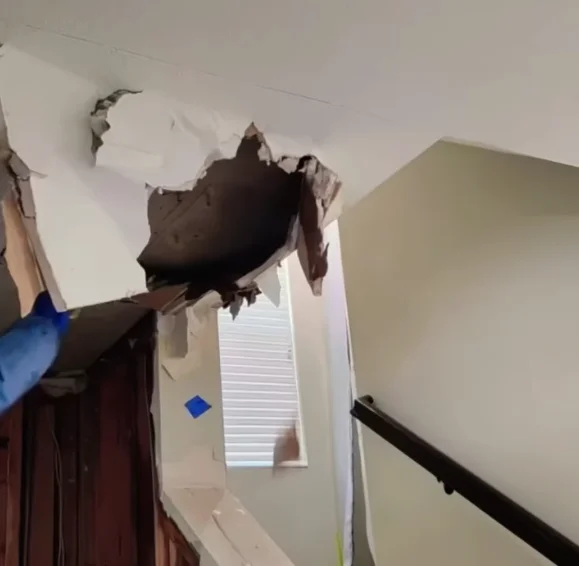
Structural compromise signs: sagging or bulging drywall (remove yourself from the area — a collapsed wet ceiling can cause serious injury), soft spots when you tap the surface, separation of the drywall tape at seams, or cracks radiating from the center of the stain. Do not attempt to catch water in buckets as a long-term solution — the ceiling material is absorbing water continuously and the weight increases until failure. Call (407) 250-7641 immediately if your ceiling is bulging.
Can ceiling water damage be repaired without replacing the drywall?
In some cases, yes — if the drywall is caught within 12 hours of water contact in Orlando's humidity, aggressive drying can restore it to dry standard without replacement. After 24 hours of exposure in Florida's climate, mold has typically established in the drywall paper backing, and replacement is required for health and air quality reasons. DryGuard assesses drywall salvageability with calibrated moisture meters before recommending replacement.
What Happens Inside Your Ceiling After a Water Leak
The ceiling stain you see is the end of a migration journey that typically started 5–14 feet away from where it appears. Understanding what happens inside the ceiling cavity helps explain why professional assessment — not just surface repair — is the correct first response.
Phase 1: Entry (Hours 0–2)
Water enters the ceiling cavity from the source above — pipe failure, condensate overflow, or roof breach. It follows the path of least resistance: along ceiling joists, pooling at low points where joists dip or where electrical boxes and HVAC registers create natural depressions in the drywall plane.
Phase 2: Absorption (Hours 2–12)
Ceiling drywall (typically 5/8" Type X in newer construction, 1/2" in older homes) absorbs water through capillary action. The paper facing absorbs first, then the gypsum core softens and loses structural integrity. In Florida's humidity, the drywall never dries on its own — it remains continuously wet as long as ambient humidity exceeds 60%, which is every day in Orlando.
Phase 3: Mold Establishment (Hours 12–48)
In Central Florida's climate, mold spores — which exist in ambient air at all times — germinate on wet drywall paper within 12–24 hours. Insulation above the drywall retains moisture significantly longer than the drywall surface, creating a persistently moist environment that sustains mold growth even after the drywall surface appears dry to the touch.
Phase 4: Visible Staining (Hours 24–336)
The brown mineral stain that eventually appears on your ceiling surface is dissolved gypsum and paper compounds carried by the water to the surface as it evaporates. Staining typically becomes visible 24–72 hours after initial water contact — meaning the mold clock started 24–48 hours before you saw the problem. The stain is not the ceiling's worst problem; the hidden mold above it is.
DryGuard's Ceiling Water Damage Assessment — What We Look For
A ceiling stain is a data point, not a conclusion. DryGuard's assessment protocol on arrival for ceiling water damage in Orlando homes:
Thermal Camera Scan
Infrared imaging reveals wet areas by temperature differential — cold saturated drywall shows clearly against the warm surrounding surface. This maps the full extent of water migration, not just the visible stain.
Calibrated Moisture Meters
Non-invasive pin and non-pin meters measure moisture content of drywall, framing, and subfloor without destructive testing. Readings above 17% in structural wood indicate drying equipment is required.
Source Identification
We inspect every possible source above the stain before assuming the most obvious one. Many ceiling events have multiple simultaneous contributing sources — a blocked AC drain that caused a second overflow while a supply line was already leaking.
Salvage vs Remove Assessment
Moisture readings, exposure duration, and mold presence determine whether ceiling drywall can be dried in place (readings below 17%, under 12 hours exposure) or must be removed and replaced (readings above 17%, or mold present).
The single most common mistake after ceiling water damage in Orlando: patching and repainting the surface without drying the cavity. The mold established in the insulation and framing above continues to grow behind the fresh paint. DryGuard has been called to remediate mold from properties that were freshly painted over a ceiling stain as recently as 60 days earlier. The remediation cost at that point is 3–5× what it would have been if the cavity had been dried properly on discovery.
Ceiling Water Stain or Sag in Your Orlando Home? Call Now.
DryGuard identifies the source, extracts the moisture, and repairs the ceiling — IICRC S500 certified, FL Mold License #MRSR3847, written estimate before work begins.