Florida Water Damage Restoration: The Complete 2026 Guide
Florida's 74–77% year-round humidity, hurricane exposure, karst limestone geology, FEMA flood zones, and specific state statutes make water damage restoration here fundamentally different from anywhere else in the US. This guide covers everything Florida homeowners need to know.
6 Factors That Make Florida Water Damage Restoration Unique
1. Mold Grows in 24 Hours
Florida's ambient humidity exceeds the 60% mold growth threshold every single day of the year. The same water event that carries a 48-hour mold window in Arizona collapses to 24 hours in Orlando or Miami. Response speed is not optional here — it is the difference between a drying job and a mold remediation job.
2. Hurricane Season Is 6 Months
June 1 through November 30, every year. Ian (2022) and Milton (2024) together caused over $100 billion in damage across Florida. The insurance classification of hurricane water damage — wind-driven rain covered by HO-3 vs. rising water requiring NFIP flood insurance — is the single most consequential claim determination in Florida restoration.
3. Karst Limestone Sinkhole Risk
Florida's limestone bedrock dissolves under sustained water, creating sinkholes that form under foundations. Orange, Hillsborough, and Hernando counties have the highest sinkhole frequency. Sinkhole formation creates foundation gaps that admit groundwater and accelerates pipe failure in supply lines running through the slab.
4. FEMA Flood Zones: 22% of FL Homes
Approximately 1.5 million Florida properties sit in FEMA flood zones AE, AH, or VE. The Substantial Damage Rule means if repair costs exceed 50% of market value, the entire structure must meet current flood code before reconstruction — potentially adding $50,000–$150,000 in foundation elevation costs before a single piece of drywall is replaced.
→ Florida 50% Rule explained5. FL Laws Protect Homeowners
§627.70131 requires insurers to acknowledge claims within 14 days and pay or deny within 60 days. §627.714 caps mold coverage at $10,000. §627.4133 prohibits policy cancellation for a single water damage claim. §468.8411 mandates separate FL licenses for mold assessment and remediation. These are your rights — know them before you call your insurer.
→ Full FL insurance guide6. AC Systems Run 10+ Months/Year
Florida HVAC systems run nearly continuously. Condensate drain lines develop algae blockages within 2–3 years and overflow silently into ceiling cavities — often undetected for weeks until staining or soft spots appear. AC condensate overflow is Florida's most underreported water damage source, frequently arriving with mo
Florida Water Damage Insurance — Key Facts
What HO-3 Covers
- ✓ Burst pipes and supply line failure (sudden and accidental)
- ✓ Appliance overflow — washing machine, dishwasher, water heater
- ✓ AC condensate overflow when sudden, not gradual
- ✓ Wind-driven rain through storm-created roof or wall opening
- ✓ Mold from covered event — up to $10,000 cap (§627.714)
What Requires Separate Coverage
- ✗ Rising water from outside — requires NFIP flood insurance
- ✗ Sinkhole damage — requires endorsement (FL insurers must offer)
- ✗ Gradual leaks — excluded as maintenance issue
- ✗ Mold over $10,000 — requires endorsement to increase cap
Key Florida Statutes
14-day acknowledgment, 60-day pay or deny. Late payments accrue interest.
$10,000 mold coverage cap. Increase by endorsement.
No policy cancellation for one water damage claim.
Separate FL licenses for mold assessment (MRSA) and mold remediation (MRSR).
Questions From Florida Homeowners
What makes water damage restoration in Florida different from other states?
Florida's 74–77% year-round humidity means mold begins within 24 hours of water intrusion — far faster than the 48–72 hours in drier climates. Combined with hurricane season from June–November, karst limestone sinkhole geology, FEMA flood zones covering 22% of properties, AC systems running 10+ months per year, and state statutes including §627.70131 (60-day claim decision), §627.714 ($10,000 mold cap), and §468.8411 (licensed mold remediator requirement), Florida is the most complex water damage environment in the continental US.
What is the Florida 33-day rule for water damage?
There is no officially named 33-day rule. Homeowners searching this term are asking about Florida Statute §627.70131, which requires insurers to acknowledge claims within 14 days and pay or deny within 60 days of receiving proof of loss. Payments made after 60 days accrue interest from the original notice date.
How much does water damage restoration cost in Florida?
Florida water damage restoration costs $860–$1,500 for minor Category 1 clean water events, $2,000–$5,000 for moderate damage with drywall involvement, and $5,000–$20,000+ for major flooding or Category 3 sewage events. Florida costs run 15–25% higher than national averages due to extended drying times required by the state's humidity.
Is mold covered by homeowners insurance in Florida?
Most standard Florida HO-3 policies cap mold coverage at $10,000 per occurrence under Florida Statute §627.714. Mold resulting from a covered sudden water damage event is included in your claim up to this cap. Mold from gradual seepage or maintenance neglect is typically excluded entirely.
How do I verify a water damage contractor is licensed in Florida?
Check FL Mold Remediator RC license at MyFloridaLicense.com. IICRC certification is verifiable at iicrc.org. Under §468.8411, separate licenses are required for mold assessment (MRSA) and mold remediation (MRSR). Always obtain a written estimate before signing any work authorization — reputable contractors provide this before any work begins.
Florida Water Damage Restoration: Choosing the Right Contractor
Florida has more licensed water damage and mold remediation contractors than almost any other US state — and more unlicensed ones as well. After a storm or significant water event, the pressure to hire quickly works against homeowners. Here is the checklist that protects you:
What to Verify Before Signing Anything
- ✓FL Mold Remediator RC License — verify at MyFloridaLicense.com. Required under §468.8411 for any mold remediation work in Florida.
- ✓IICRC Certification — verify at iicrc.org. WRT (Water Restoration Technician) and ASD (Applied Structural Drying) are the core credentials for water damage restoration.
- ✓Written estimate before work begins — any contractor unwilling to provide a written scope before starting is a significant red flag. Florida law does not require you to sign same-day.
- ✓Florida physical address and license plate — storm chasers arrive in vehicles with out-of-state plates within 48 hours of a named storm. Local contractors are already serving their existing client base and inbound calls.
- ✓No Assignment of Benefits pressure — residential AOB was effectively eliminated in Florida in 2023. Any contractor requesting AOB signature is operating with outdated or fraudulent contracts.
Red Flags to Watch For
- ✗Unsolicited door-to-door visit within 48 hours of a storm
- ✗Cannot produce a FL Mold Remediator license number on request
- ✗Requests signature on an Authorization to Perform Services before providing a written estimate
- ✗"We'll deal with your insurance company directly" — without explaining specifically how
- ✗No local office address; uses a PO Box or mobile phone only
- ✗Unusually low estimate — typically signals scope shortcuts that leave moisture behind
- ✗Pressure to start work before your adjuster has been notified
DryGuard FL Mold Remediator License: #MRSR3847. Verify: MyFloridaLicense.com
Florida Water Damage Timeline: What to Expect After a Major Event
Standing water removed. Cause-of-loss documented. Moisture mapped with thermal imaging. Insurance claim filed or notification sent.
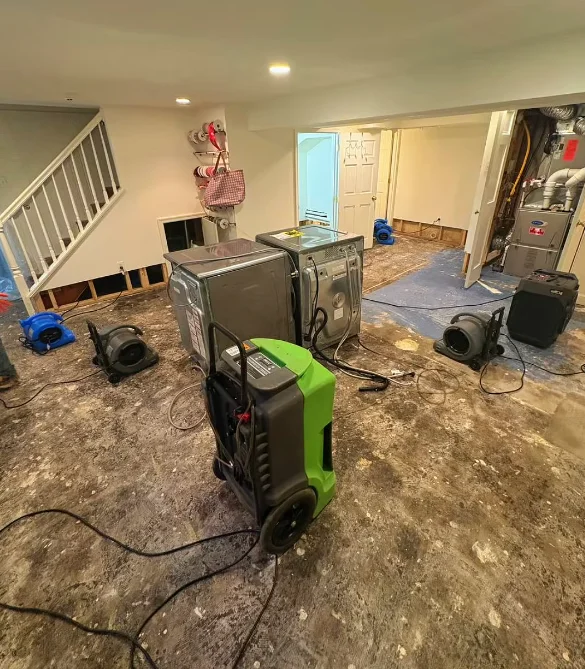
LGR dehumidifiers and air movers operating continuously. Daily moisture readings logged. Adjuster visits during this phase in most FL claims.
Final moisture readings confirm materials are at or below IICRC dry standard. Equipment removed. Mold assessment completed if indicated by exposure timeline or readings.
Affected materials removed, antimicrobial treatment applied, clearance testing performed. FL Mold License required for all mold work in Florida.
Drywall replacement, flooring, painting, and finish work. Timeline depends on scope, material availability, and insurance approval for reconstruction costs.
Water Damage Anywhere in Central Florida? We Answer 24/7.
IICRC-certified DryGuard Restoration serves Orlando and all of Orange County. Florida insurance documentation specialists. Written estimate before any work begins.